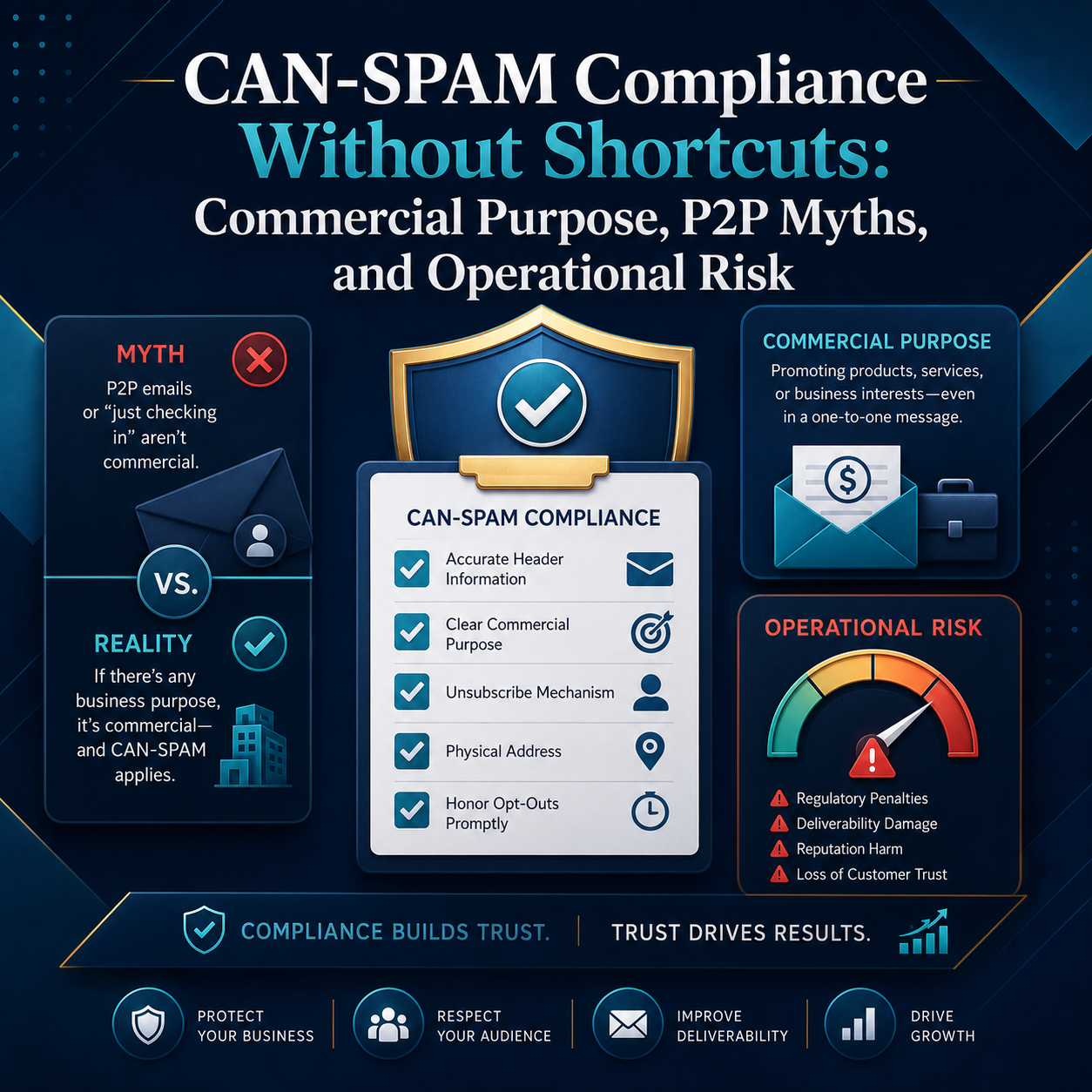
The CAN-SPAM Act is often reduced to a handful of footer requirements. That is too narrow. Compliance begins with the message's purpose, the truthfulness of its routing and subject line, the identity of the sender, and the recipient's ability to stop future commercial mail.
Commercial purpose matters more than the send button
The Federal Trade Commission explains that CAN-SPAM applies to commercial messages and does not create an exception merely because the message is business-to-business, sent one at a time, or delivered through software described as peer-to-peer. The statute and guidance focus on the nature and initiation of the message—not whether a database loop opened one SMTP connection per recipient.
Calling a system “P2P,” individually addressed, decentralized, offshore, artificial-intelligence generated, or non-bulk does not by itself remove a commercial message from CAN-SPAM.
The core operational checklist
- Use accurate From, To, Reply-To, domain, and routing information.
- Use a subject line that accurately reflects the content.
- Clearly identify advertising when required.
- Include a valid physical postal address.
- Provide a clear, conspicuous, functioning opt-out method.
- Keep the opt-out mechanism available for the required period and honor requests promptly.
- Do not sell or transfer addresses after an opt-out except for permitted compliance processing.
- Monitor vendors and affiliates sending on your behalf.
The slippery slope of mixed-purpose messages
A receipt, account notice, or security alert can be transactional. Add promotional content, move the transactional explanation below a sales pitch, or use a promotional subject line, and the message's primary purpose may become commercial. The practical safeguard is separation: keep necessary relationship communications focused, and send marketing through a clearly governed marketing program.
Bulk versus individually transmitted mail
Bulk software affects throughput, provider limits, reputation, and operational controls. It can also affect evidentiary questions about who initiated a message. But the FTC's business guidance states that CAN-SPAM covers commercial email and is not limited to traditional bulk blasts. One-to-one automation can still create repeated violations if the underlying content or process is unlawful.
Build compliance into the platform
- Require a campaign purpose and permission attestation.
- Maintain organization-scoped suppression lists.
- Insert a stable unsubscribe URL into every commercial template.
- Stop queued sends immediately after an opt-out.
- Preserve the exact content, headers, recipient record, consent evidence, and suppression event.
- Review audience sources and prohibit harvesting, dictionary generation, deceptive acquisition, and purchased lists that cannot be lawfully used.